
The Miami Open and the Never-Ending Quest For World No. 1
08.11.26
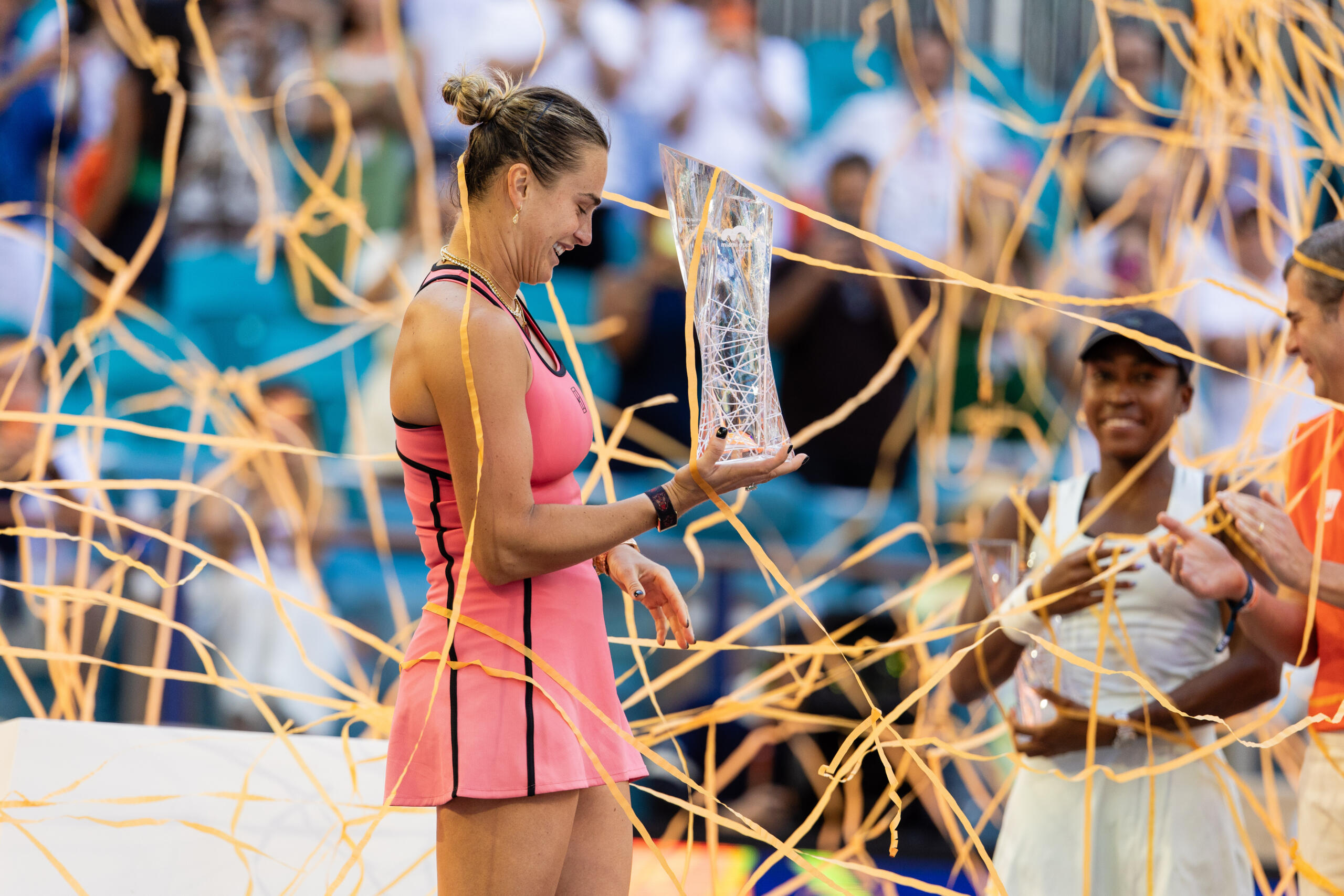
2026 Miami Open women’s singles champion Aryna Sabalenka has held the WTA’s world No. 1 ranking for 96 consecutive weeks.
Ethan Silipo, Contributor
The Race for No. 1
In one calendar year, professional tennis hosts four Grand Slam events, nine ATP and ten WTA 1000-level events, in addition to dozens of tournaments in between to create a near-constant cycle of competition. Hidden beneath the grind is an exclusive race reserved for the sport’s elite: the quest for the world No. 1 ranking.
It’s a defining line for some of tennis’ greatest resumes. Roger Federer holds the record for most consecutive weeks at No. 1 when he rattled off 237 straight weeks from 2004 to 2008. Steffi Graf and Serena Williams share the women’s record with 186 continuous weeks. Novak Djokovic’s 428 total weeks are the most ever at the top slot.
The absence of a world No. 1 ranking is hardly a blemish on any career, however. Legends like Stanislas Wawrinka, Alexander Zverev, Juan Martin del Potro, and Dominic Thiem built storied careers without ever reaching No. 1, despite winning Grand Slams and defeating some of the best of all time. The exclusivity of the achievement is what makes it so coveted:
Tennis’ ranking system is its most comprehensive measure of ability. Points remain a part of player’s totals for 52 weeks after being awarded, meaning at any point in time, a player’s point total is representative of their last year of tennis. A high ranking is the result of success on hard courts, clay, grass and indoor hard courts. It compiles performances from the cheers of Paris to the greens of London, all the way back to the energy of Miami. In tennis, it’s not enough to be good occasionally: you must make excellence a habit.
Miami’s Predictive Power
In the modern landscape, No. 1s Jannik Sinner and Aryna Sabalenka exemplify excellence better than anyone.
Sinner holds a firm grasp on the top ATP spot with more than 5,000 points separating him from No. 2 Carlos Alcaraz, though both players notably withdrew from this year’s Cincinnati Open with injuries. The women’s race is much tighter with less than 500 points separating No. 1 Sabalenka from No. 2 Elena Rybakina. If Sabalenka exits the upcoming Toronto tournament before the Round of 16 and Rybakina makes a title run, their rankings could swap.
The battle for year-end No. 1, finalized in early November, remains far from settled, but history suggests Miami may already have provided an important clue. Less than five months ago, current frontrunners Sinner and Sabalenka lifted their trophies at the Miami Open presented by Itaú. While success in March guarantees nothing in November, the tournament has a remarkable track record of predicting which players will finish in the top slots.
On the every Miami Open champion of the last 25 years has finished in the Top 14. Of those 25, 15 finished the year in the top three and The men’s side sees similar consistency with nearly every champion in the last 25 years finishing in the Top 10, save for 2025’s champion No. 19 Jakub Mensik.
By the numbers, this means men and women who win the Miami Open presented by Itaú have an approximately one in three chance of finishing the year at No. 1.
The Sunshine Double Effect
The significance only grows when Indian Wells enters the picture. Together, the two tournaments form the iconic “Sunshine Double,” one of the most difficult achievements in professional tennis. Only eight men and five women have ever won both singles titles in the same season, and those who pull it off often carry that momentum throughout the year.
Half of the women to complete the Sunshine Double went on to finish the season ranked No. 1, and Sabalenka could add her name to that list this year. On the men’s side, Sinner could become the seventh ATP Sunshine Double champion in the last 25 years to finish the year at ATP Year-End No. 1.
Part of the correlation between the Sunshine Double and world No. 1 may seem obvious: winning two Masters 1000-level titles back-to-back delivers 2,000 points and provides a huge foothold early in the season.
There is another reason these early-year hard-court tournaments may be especially indicative. After opening the year largely on hard courts, the tour shifts to clay in early April, grass in June then returns to hard courts in late July. From August on, the tour is dominated by indoor and outdoor hard courts. To finish the year with a strong ranking, players need to rattle off several months of success on hard courts.
Those who thrive in Indian Wells and Miami have already demonstrated the skills needed to succeed in the home stretch. That’s why the Miami Open presented by Itaú has proven to be more than an early season stop on the calendar. Year after year, it serves as an early indicator of who will shape the sport’s biggest storylines, contend for Grand Slam titles and ultimately compete for the No. 1 ranking.
Latest Articles
10.13.26